Is Light Pollution a Deal Breaker for Wide-Field Astrophotography?
For some photographers, the answer is an unequivocal yes. For others, myself included, the question is far more nuanced than that.
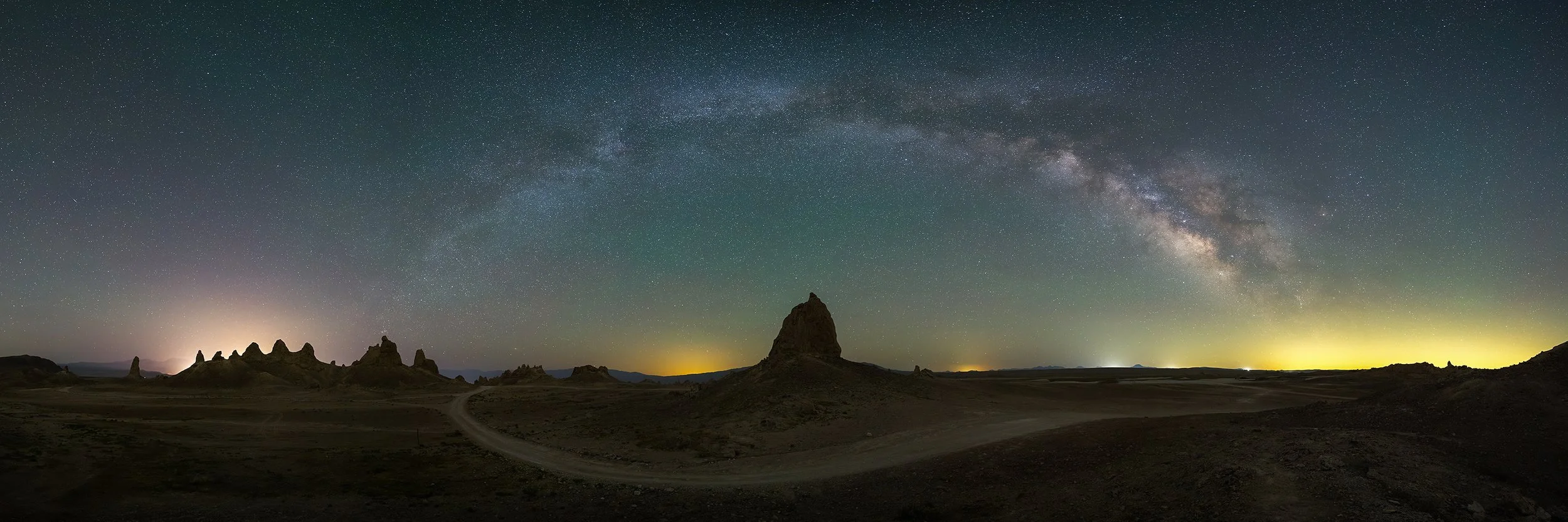
The Milky Way arching over Trona Pinnacles as city lights from Los Angeles, Las Vegas, Barstow, and nearby mining operations illuminate the horizon.
Recently, I overheard a fellow photographer say they had given up on night sky photography entirely, defeated by a combination of worsening light pollution and the ever-growing proliferation of satellites now streaking across the night sky. I understood the frustration immediately, and I won't pretend those aren't real things. But I'd be lying if I said my heart didn't sink a little hearing it. The night sky still has an enormous amount to offer to the willing photographer. The images are still out there, waiting to be made. All it takes is a willingness to look past imperfect conditions, a trained eye for what's possible within them, and the resolve to actually get out and make the time. That, in the end, is what separates the photographers who keep shooting from the ones who stop.
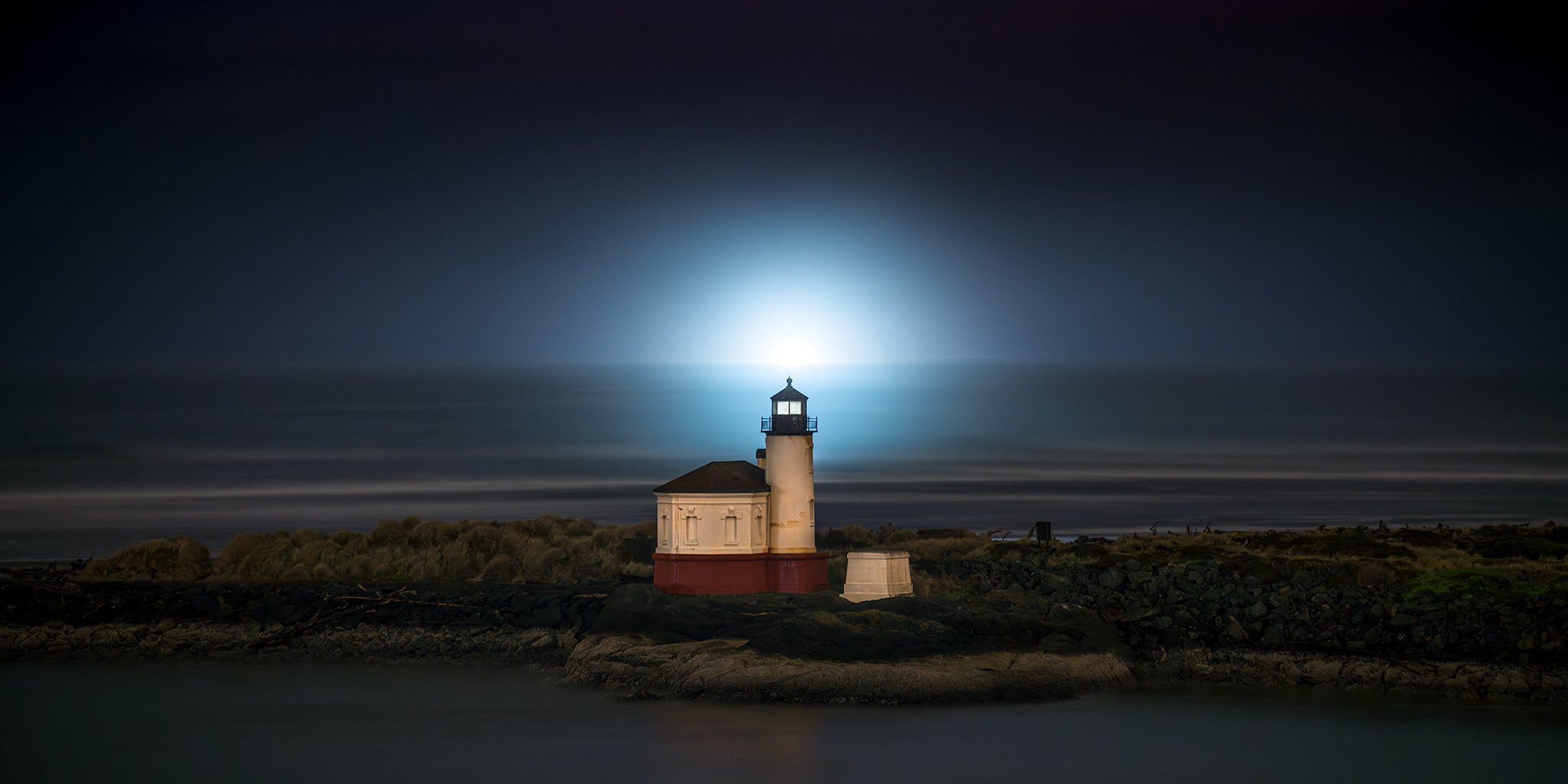
The Coquille River Lighthouse as a distant fishing vessel passes behind. The front illumination is entirely ambient light from the town of Bandon across the river.
This piece is accompanied by a selection of nighttime and wide-field astrophotography images I've captured over the years, each one made under skies affected, to some degree, by light pollution. I want to be upfront about this: I'm not here to celebrate or excuse senseless artificial light blazing into the night sky. What I am here to do is challenge the perfectionist in you, the photographer who has talked themselves out of heading outside because the conditions weren't ideal. Because the truth is, you never really know what an image will look like until you capture it. And sometimes, against all expectation, it just works.
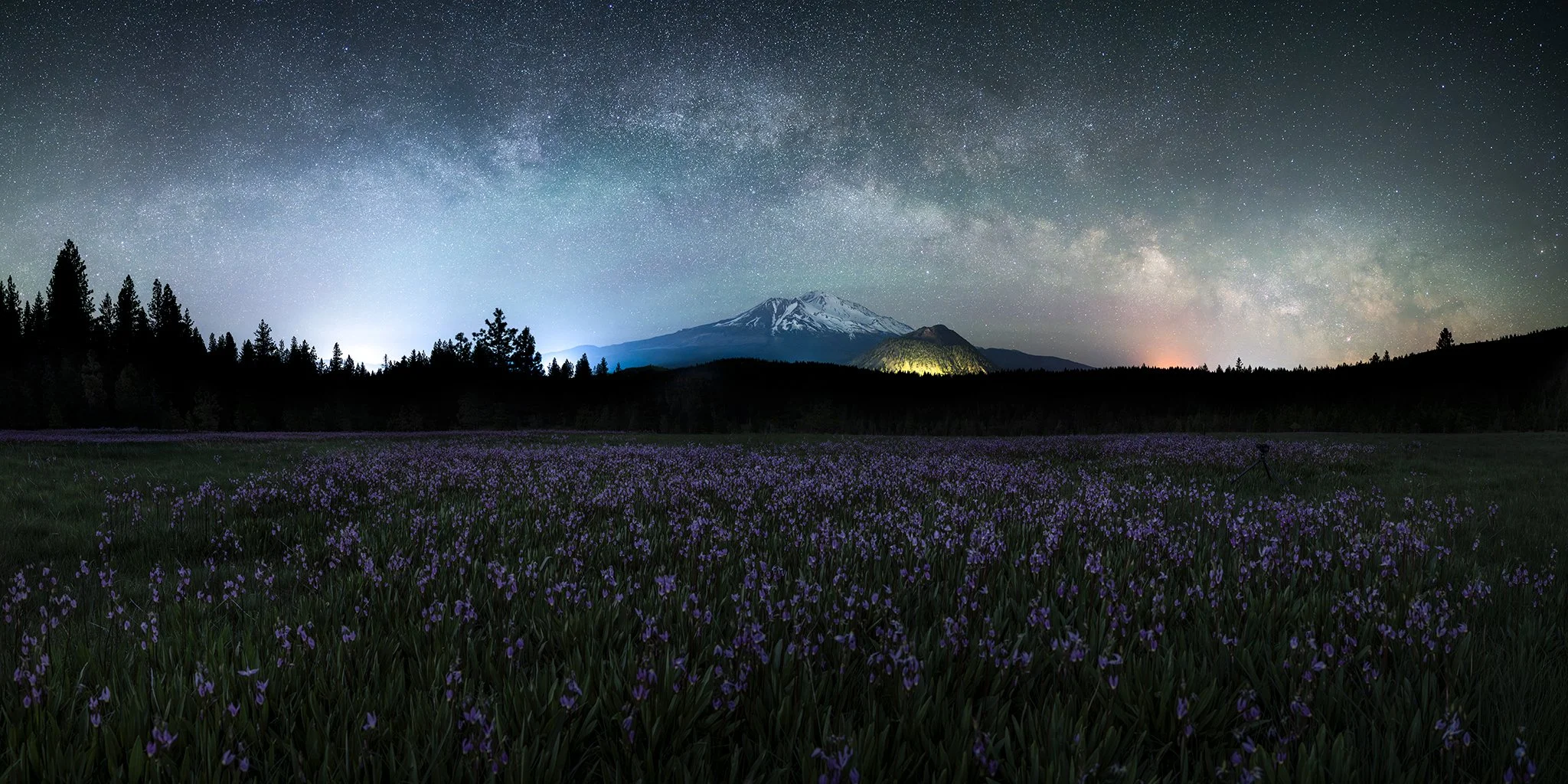
The Milky Way rises over Mt. Shasta and a field of Shooting Star flowers.
Left: The town of Weed glows brightly. Center: Black Butte is illuminated by the lights of Truck Village. Right, the orange glow of a fire and the lights of Mount Shasta City.
Understanding Sky Darkness: The Bortle Scale
To put things in context, it helps to understand how astronomers and astrophotographers talk about sky quality. The standard reference is the Bortle Scale, a nine-level numeric system developed by amateur astronomer John Bortle in 2001. At one end of the scale sits Class 1: the rarest, most pristine darkness found only in the most remote corners of the Earth, where the Milky Way casts an almost visible shadow and the sky glows faintly with natural airglow. At the other end is Class 9: the washed-out luminous haze of an inner-city sky, where only the Moon and the brightest planets manage to pierce the glow.
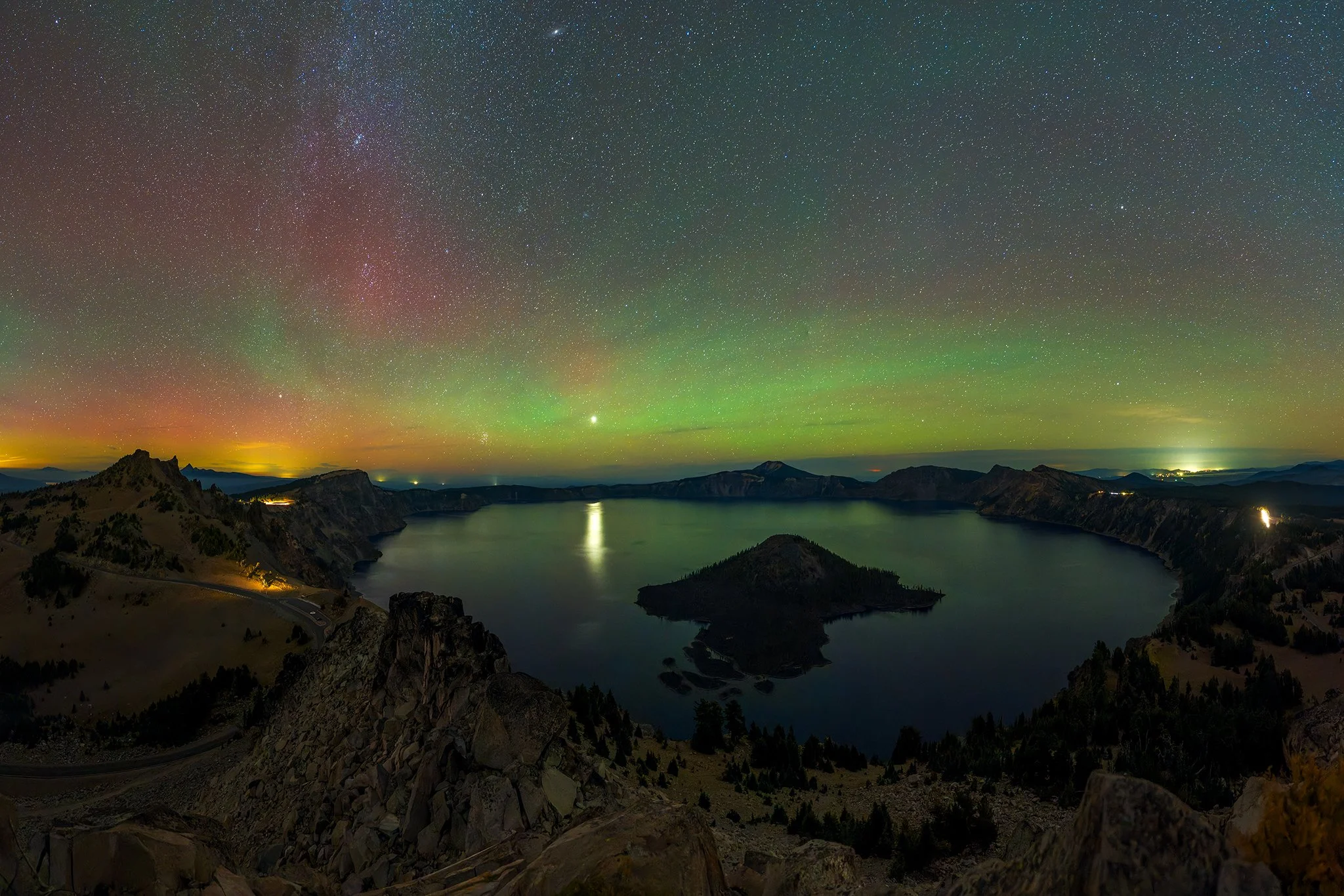
Crater Lake panorama from the top of The Watchman during intense airglow and faint aurora. The city of Bend on the left and Klamath Falls on the right notably visible on the distant horizon.
A lot of us live and shoot somewhere in between. Increasingly, even those of us who venture deep into rural lands are finding that "in between" is creeping in a troubling direction. For reference, a list of remaining Bortle Class 1 state and national parks in the US can be found here: https://www.go-astronomy.com/bortle-class-1-sky-sites.php
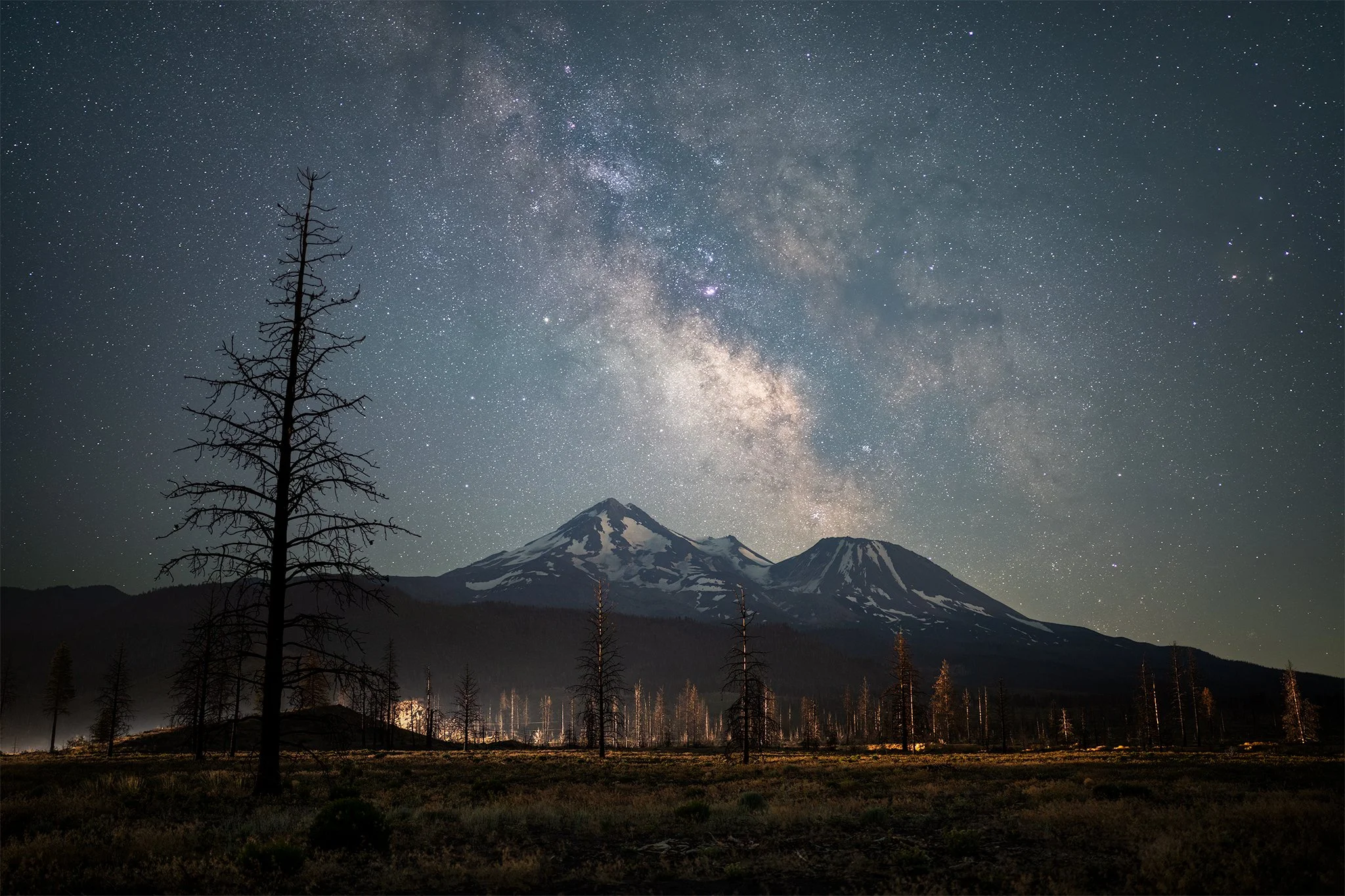
The Milky Way over Mt. Shasta on a slightly hazy summer night as a coming train illuminates the midground.
A Vanishing Darkness
I've been fortunate. Much of my life has been spent under genuinely dark skies, Bortle 2 and 3 conditions, and I've made it to Bortle 1 locations more than a few times.
One of my earliest and most vivid memories of true darkness comes from Copco Lake, California, a small, tucked-away community nestled between steep canyon walls in Siskiyou County, near the Oregon border. My grandfather lived there when I was young. At the time, the community was home to perhaps a hundred people at most and probably even less today. There were no street lights, no LED garden path lights, none of the ambient glow we've come to accept as a permanent feature of the nighttime landscape. It was dark in the way that only truly remote places can be: profoundly, completely, almost disorienting dark. I can still picture the Milky Way arching overhead on clear summer nights, dense, layered, almost three-dimensional in its richness. It's a sky I rarely encounter anymore, and one that stays with you forever once you see it.
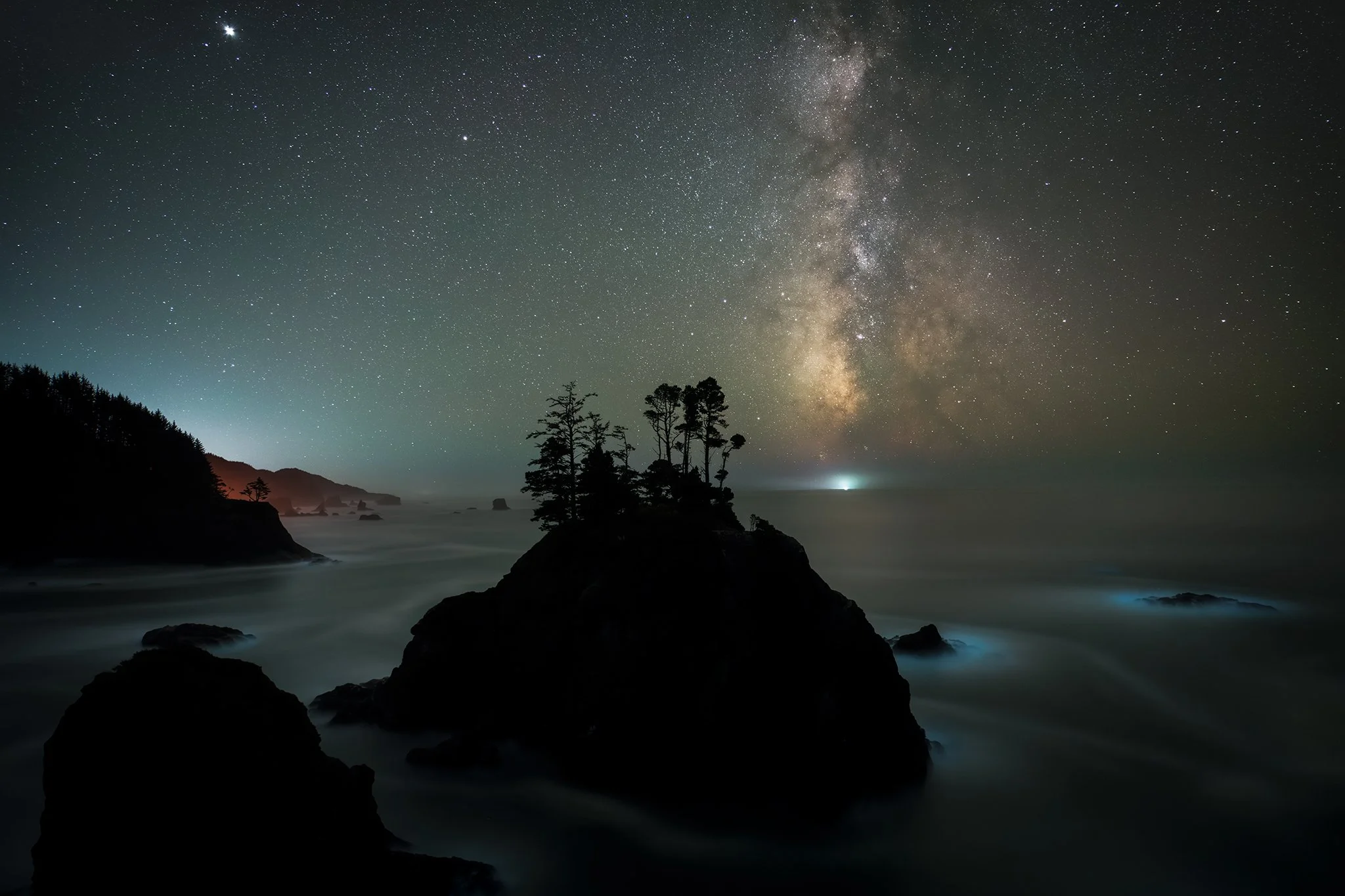
September night sky over the Southern Oregon Coast as the town of Brookings glows on the left, bioluminescence on the right, and a distant fishing vessel beneath the Milky Way on the horizon.
That quality of darkness is becoming harder and harder to find, even in regions that, until recently, were reliably rural and dim. Siskiyou County, where I still spend a great deal of time photographing, has grown noticeably brighter over just the past few years. The culprit, in large part, is a familiar one: the widespread replacement of older high-pressure sodium street lights with modern LED fixtures. The sodium lights had a certain photographic grace. Their warm amber-orange glow was relatively dim, directional, and narrow in spectrum. The new LEDs are a different matter entirely. They're dramatically brighter, broad-spectrum, and their light seems to scatter in every direction rather than focus downward. The result is a diffuse, cool-white haze that contaminates the sky in ways the old lights simply didn't. Add in the relentless blaze of LED gas station sign boards, piercing through the night with the subtlety of a floodlight, and you begin to understand how quickly things are changing.
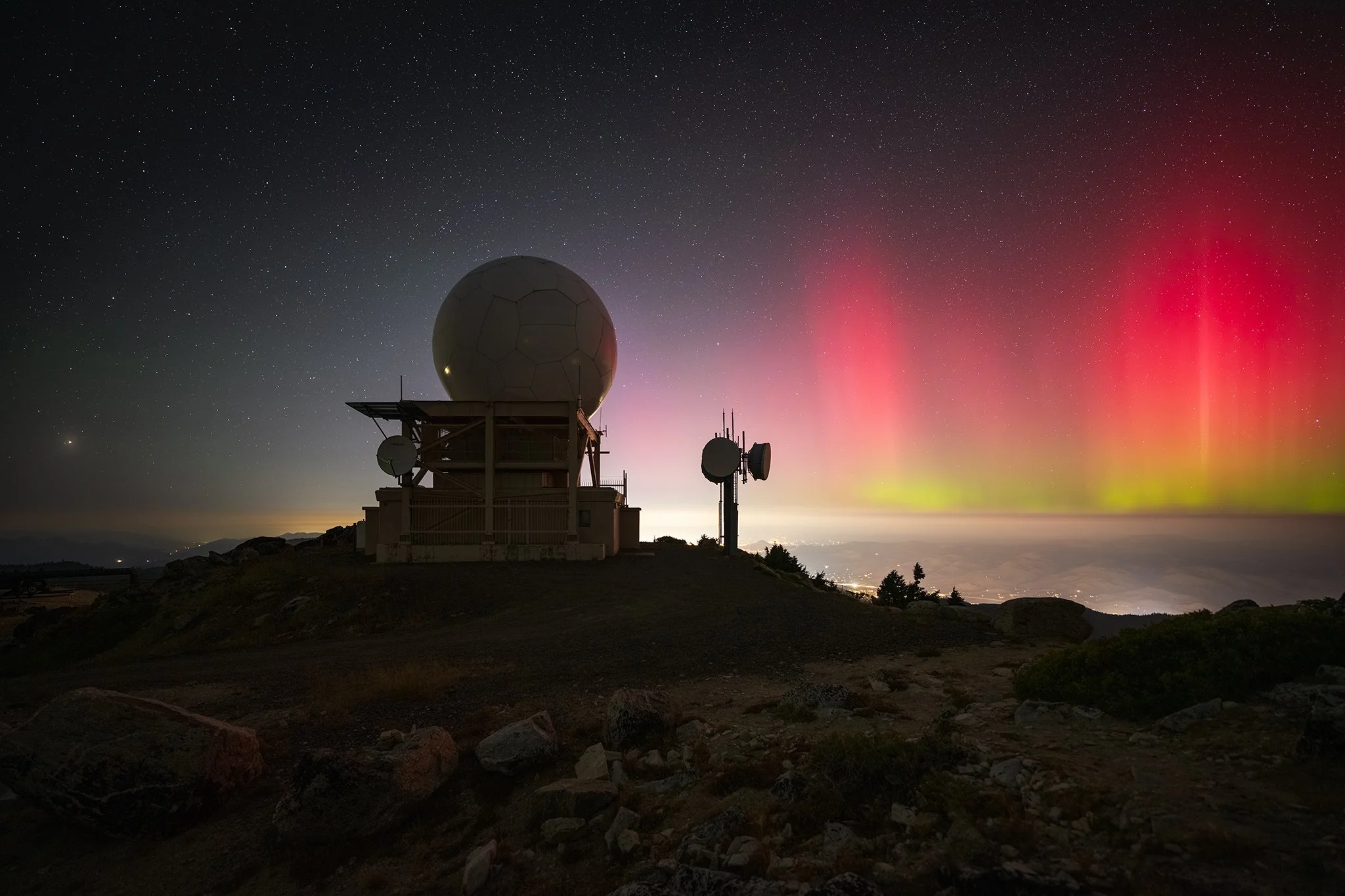
Northern Lights dance above an inversion layer of wildfire smoke and light haze from the Rogue Valley below.
The broader trend is not unique to Siskiyou County. One of the annual workshops I teach focuses specifically on capturing the Milky Way over Mt. Shasta, a subject I've devoted many nights to over the years. Locations I photographed from just a few years ago are measurably brighter now. Some of them, frankly, are no longer usable for serious night photography at all. I find myself driving farther, scouting more carefully, and adjusting my compositions to work around light infiltration that simply weren't there before.
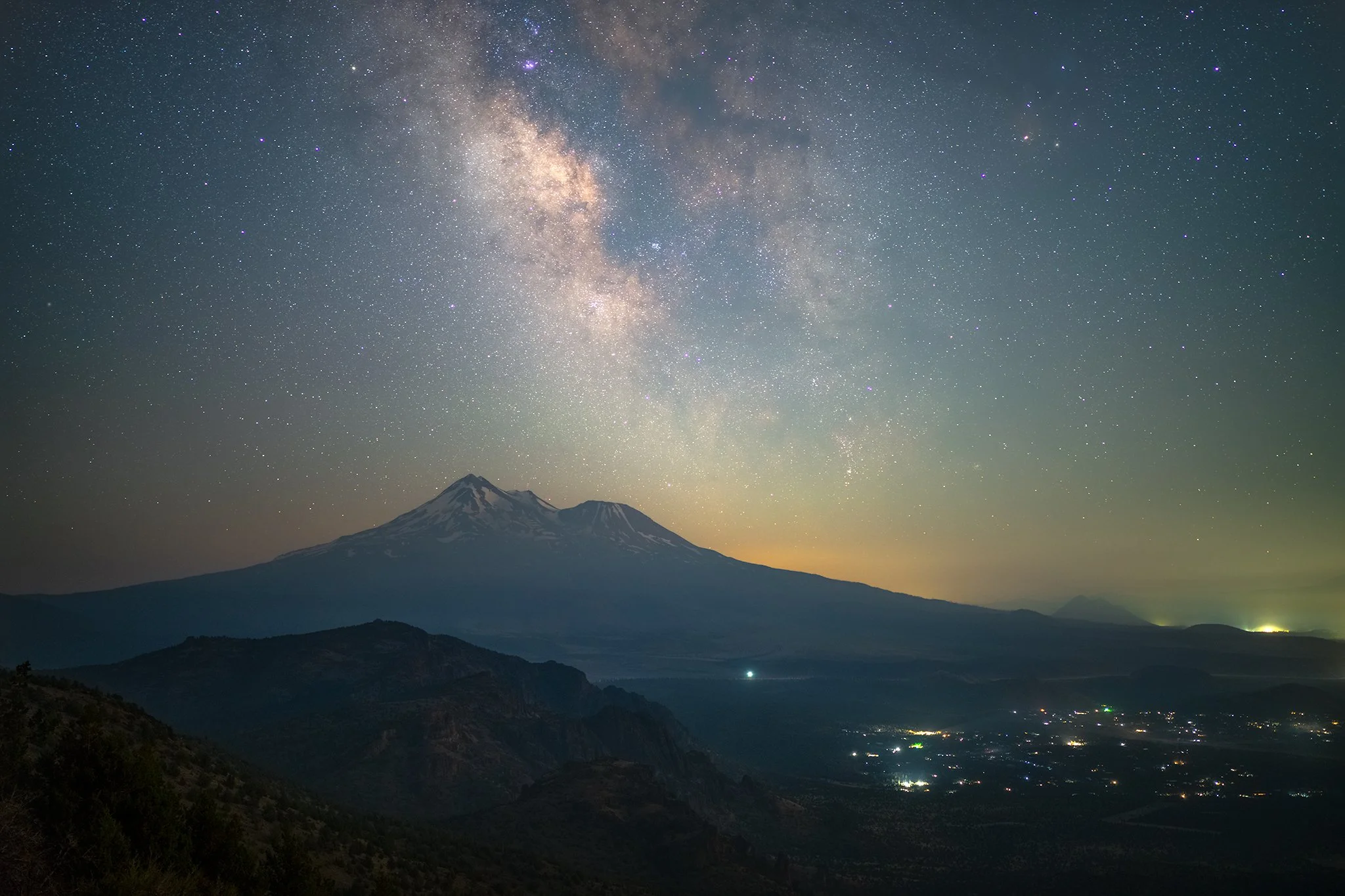
The Milky Way over Mt. Shasta on a hazy summer night with light pollution all around.
Non-photographers may not notice these changes at all. But with modern camera sensors, increasingly sensitive to wavelengths the human eye barely registers, even the faintest ambient light can render on a long exposure as a vivid, sweeping glow across the horizon.
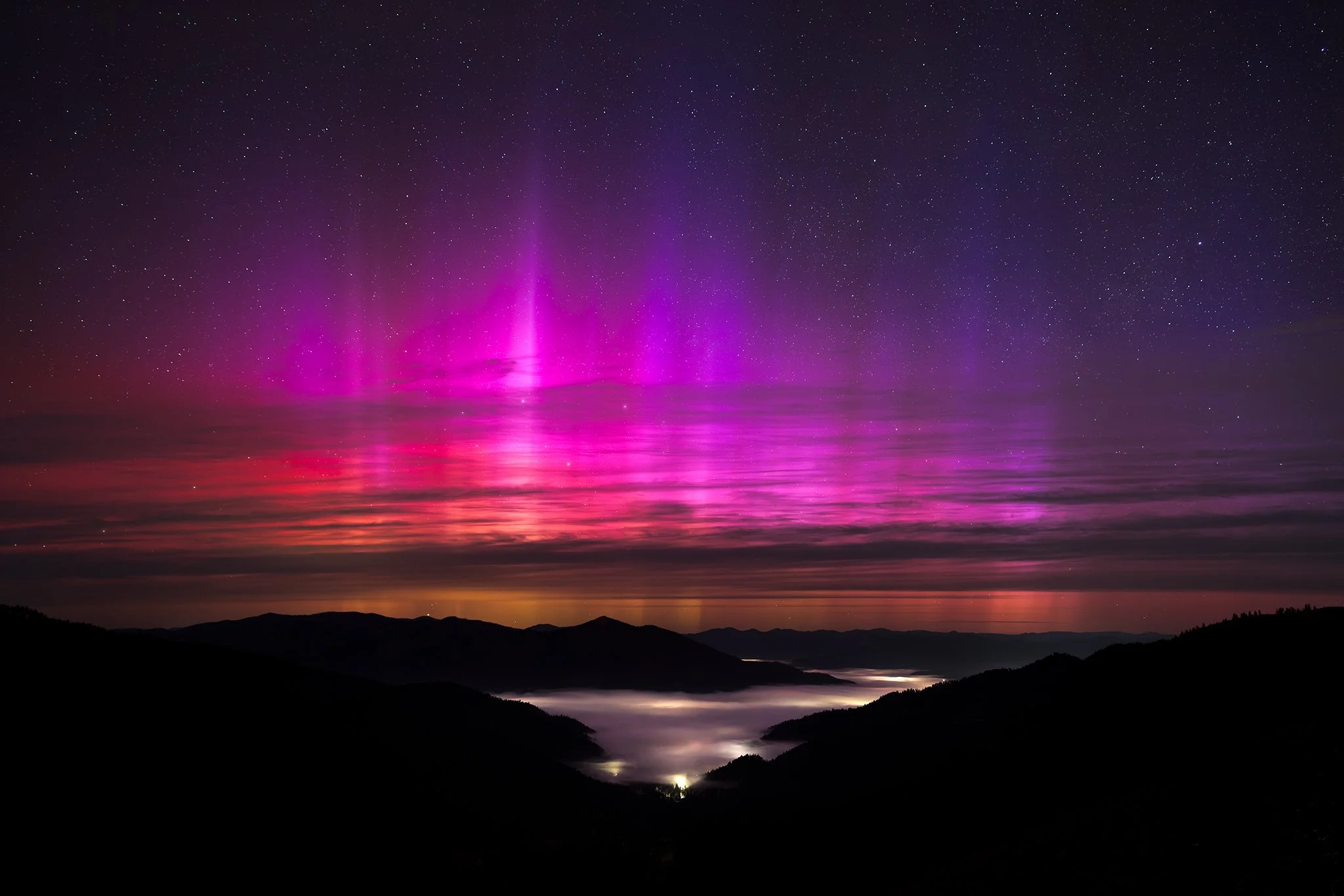
Northern Lights fill the sky over a fog inversion and the town of Rogue River, Oregon.
Embracing Imperfection
But here's where I want to shift gears, because this isn't meant to be an elegy. It's meant to be an invitation.
Yes, the skies are changing. Yes, the darkness we once took for granted is retreating. Those are real losses worth documenting and discussing. But dwelling only on what's gone risks something equally damaging: paralysis. The belief that if conditions aren't perfect, the image isn't worth making.
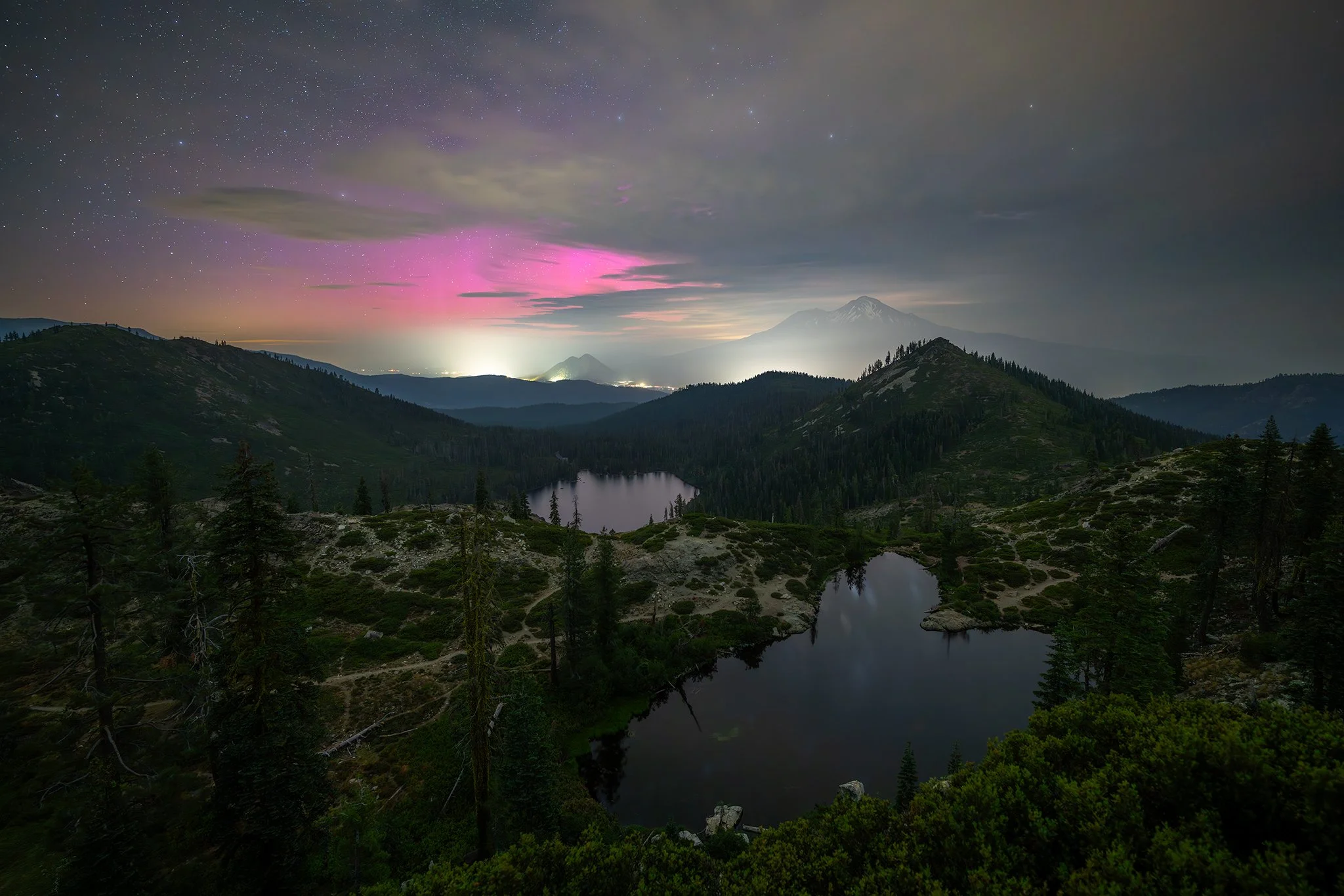
Wildfire smoke haze, clouds, and the distant glow of the aurora mix with the lights of Weed and Mount Shasta City. Heart Lake and Castle Lake in the foreground.
Light pollution, like weather, like haze, is simply another condition to work with, not necessarily a reason to pack up and go home. A distant city glow warming the horizon can anchor a composition. A gradient of amber or blue can give a photograph atmosphere and a sense of place that a perfectly "clean" sky sometimes lacks. Context and imperfection can be powerful tools when you stop fighting them and start working with them.
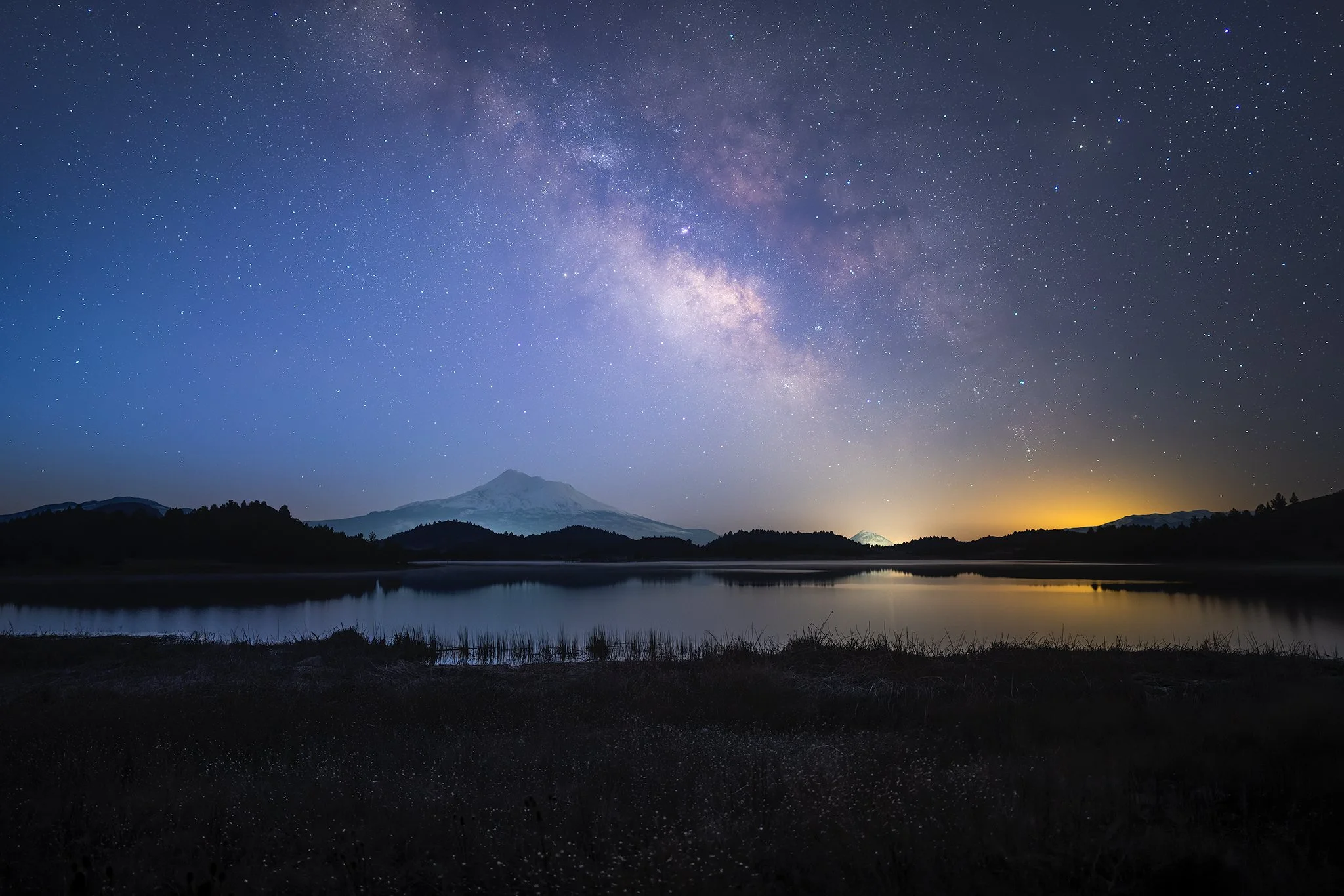
Dawn light and the Milky Way over Mt. Shasta as the city of Redding glows brightly 100 miles to the South,
The images I've included here were all made under compromised skies. None of them came from a Bortle 1 location. Some were shot within sight of small-town light domes; others within range of agricultural and highway lighting or fishing vessels. All of them, I think, were worth making. Some of them are among the images I'm most glad I didn't talk myself out of.
So get out and shoot. Find the inspiration. Document the sky as it is now. Push your equipment and your creative eye to find the image within the imperfection. Because the night sky, even a compromised one, is still extraordinary. And the photograph you don't take is the one you'll never have.
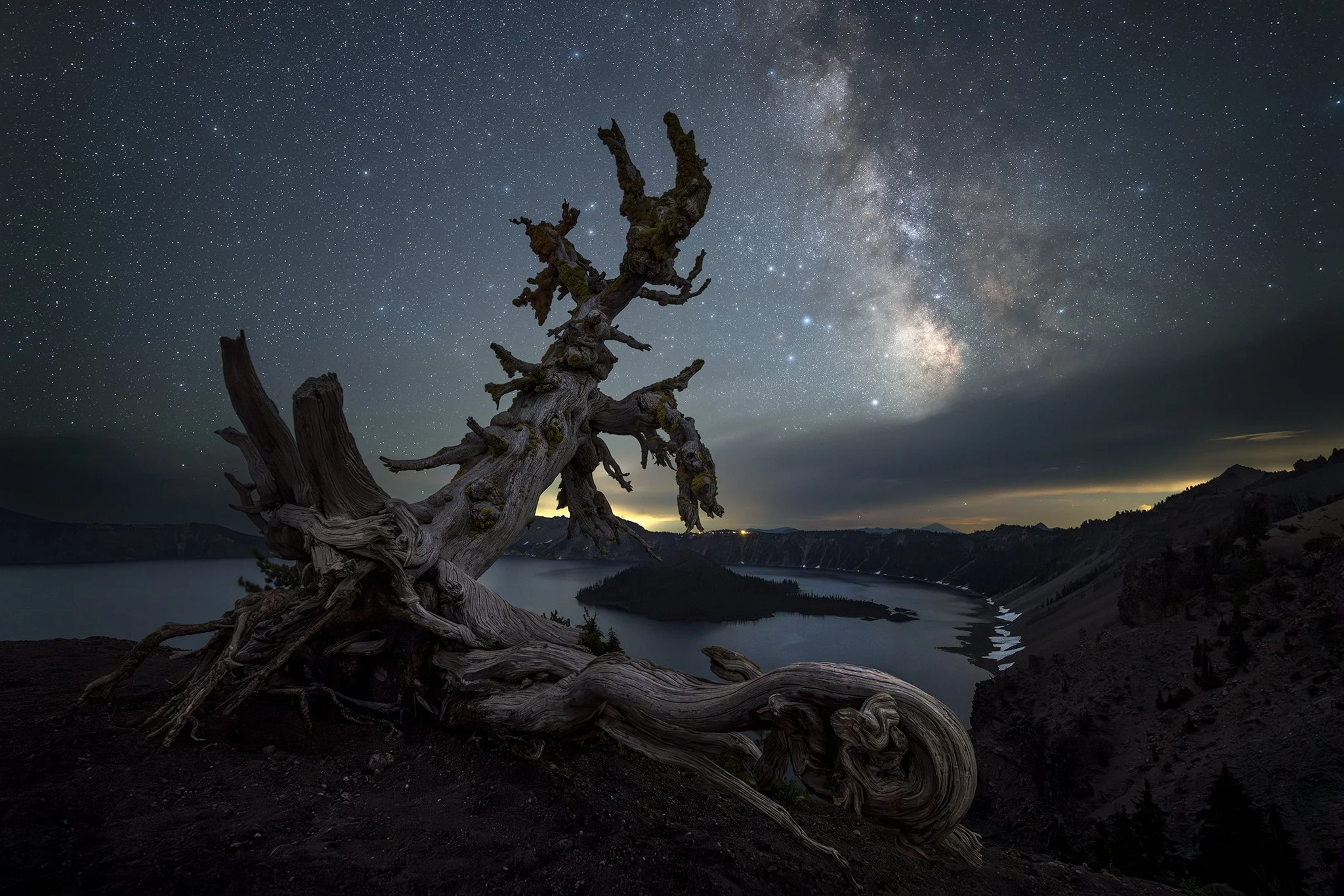
“The Sentinel” at Crater Lake National Park as Klamath Falls and Medford glow on either side of the Milky Way.